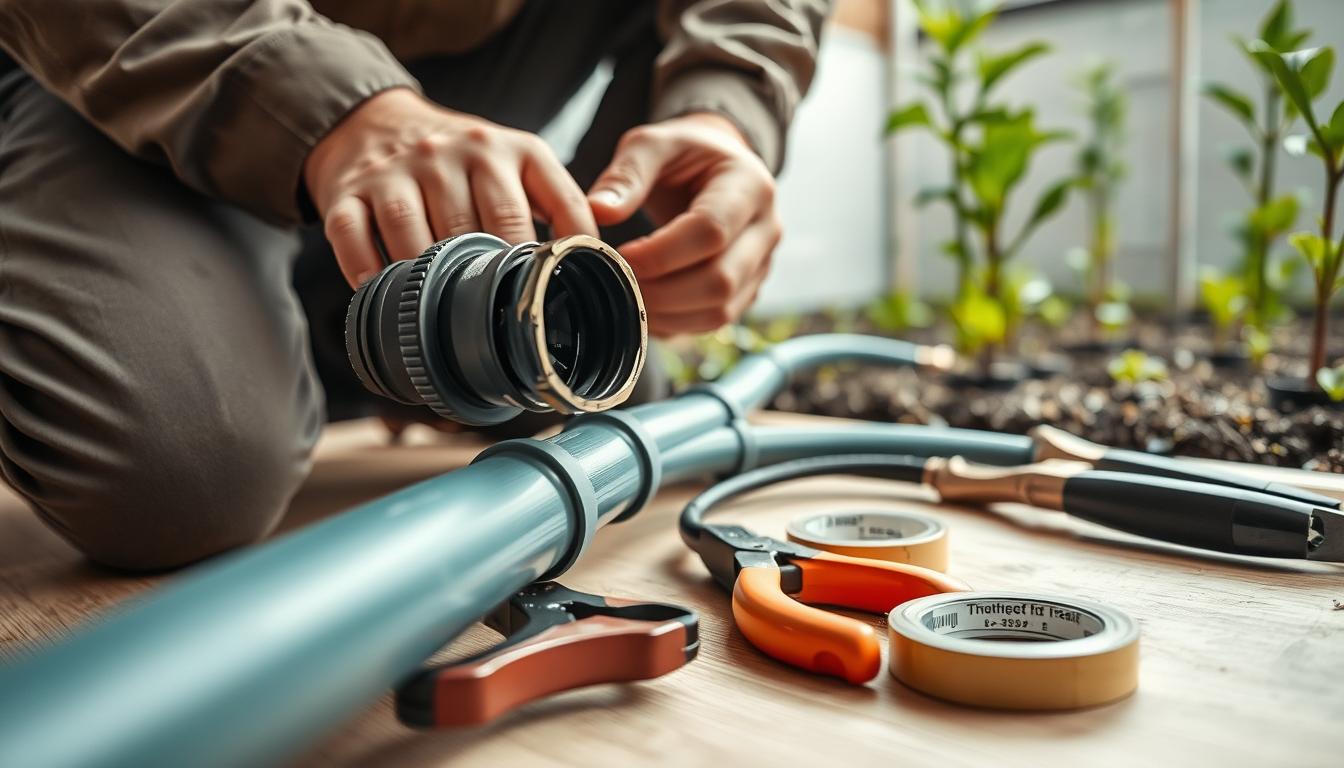
A drip tape end cap usually blows off because the end connection is under more stress than it can hold. That stress may come from high water pressure, a loose or wrong-sized cap, a stretched tape end, debris inside the line, or a layout issue that pushes too much force toward one run.
Start with diagnosis before replacing parts. In many backyard drip systems, the fix is simple: turn off the water, inspect the tape end, flush the line, reseat the cap, and check whether the system pressure makes sense for drip tape.
Quick answer
If your drip tape end cap keeps blowing off, check pressure first, then check cap fit and tape condition. A new cap may help when the old one is loose or worn, but it will not solve the problem if the tape end is stretched, the line is clogged, or the system is running too forcefully.
The safest troubleshooting order is: shut off the water, remove the cap, flush the tape, cut back damaged tape if needed, reinstall a compatible end cap, then run the system slowly while watching the connection.
A blown-off drip tape end cap is usually a symptom. The repair works better when you fix the pressure, fit, or blockage behind it.
Key takeaways
- High pressure is one of the first things to check when the same end cap keeps popping off.
- A cap can fail if the drip tape end is stretched, cracked, folded poorly, or cut unevenly.
- Debris inside the line can create flow problems and put extra stress on weak connections.
- A replacement end cap is useful only when it matches the tape size and the tape end is still in good shape.
- Do not replace the whole drip line until you check the smaller failure points first.
Helpful products at a glance
These support parts match the most common causes of drip tape end-cap failure. Use them only after you have a good idea of what is causing the problem.
Best for pressure and debris support because it combines regulation and filtration
- Ideal for use with all 3/4” Pipe Thread water sources for drip irrigation systems
- All-purpose screen filter with built-in 25-PSI pressure regulator for use in drip irrigation or micro sprinkler systems

Best for pressure diagnosis because it helps check before replacing parts
- Pressure Tester Gauge Kit: 3/4 inch GHT garden hose quick connector,1/4" adapter,1/2" adapter and Push-to-Connect Fittings(1/2 Inch Tube OD and 3/8 Inch Tube OD). 3/4”female hose thread adapter quickly attaches to outside faucet or hose bib.
- Wide Range of Uses : Oil Filled Pressure Gauge helps you plan and design efficient water-saving irrigation systems. Has a 3/4 Inch Female Hose Thread adapter and 5 adapters to easily connect to outdoor pool cleaning system,Patio Fixtures, Swimming Pools, hose bib and any Other Water Systems.

Best for failed end-cap replacement because it targets the loose fitting point
- INCOMING PRESSURE: 30 PSI
- UNIVERSAL FIT: Fits all brands 5/8" - 1/2" or .625" - .645"

Start with this fast troubleshooting checklist
Before you buy a new cap, walk through the basic checks. They can save you from replacing the wrong part.
- Turn off the water before touching the tape or fitting.
- Remove the end cap and inspect the tape opening.
- Look for stretched, split, cracked, or unevenly cut tape.
- Flush the line before closing the end again.
- Confirm that the cap matches the drip tape size.
- Check whether the cap seats firmly without forcing it.
- Run the system slowly and watch the connection for movement.
Use the symptom to narrow the cause
| What you notice | Likely cause | First fix to try |
|---|---|---|
| Cap pops off soon after water turns on | Pressure may be too high or the cap is not seated well | Check pressure, reseat the cap, and restart the system slowly |
| Cap feels loose even when installed | Wrong cap size or worn fitting | Confirm tape size and use a compatible replacement cap |
| Tape end looks stretched or cracked | Damaged tape end | Cut back to a clean section and reinstall the cap |
| Water flow looks uneven along the row | Clogging, debris, or layout imbalance | Flush the line and check for blocked sections |
| The same run fails repeatedly | Pressure, length, branching, or restriction issue | Inspect the full run instead of replacing only the cap |
Check pressure before blaming the end cap
Drip tape is not meant to handle the same force as a regular open garden hose. If the water source is pushing too much pressure into the line, the weakest connection may fail first. Often, that weak point is the end cap.
A pressure problem can look like a cap problem because the cap is the part you see flying off. Still, the real issue may be upstream. If your system has no pressure regulation, or if the end cap blows off right after the water turns on, pressure should be near the top of your list.
A simple pressure gauge can help confirm whether the system is running too forcefully before you start replacing drip tape parts. It does not fix the problem on its own, but it can keep you from guessing.
When you check pressure, do it as close to the irrigation setup as practical. A reading from the house supply alone may not tell you what the drip tape is actually receiving after timers, splitters, filters, or other attachments.
When a regulator and filter may help
If pressure or debris appears to be part of the problem, a combined filter and pressure regulator can support the system before water reaches the drip tape. This is most useful when the setup lacks pressure control near the water source or when small debris keeps entering the line.
Do not treat a regulator as a cure for every blown-off cap. You still need to check the tape size, cap fit, damaged ends, clogs, and thread compatibility. A pressure-control part only helps when it matches the system and the failure is actually tied to pressure or debris.
Inspect the end cap and tape end
If pressure looks reasonable, move to the connection itself. A drip tape end cap can fail because it is the wrong size, not pushed in or locked correctly, worn out, or installed on tape that is no longer clean and round enough to hold.
Remove the cap and look closely at the end of the tape. If the opening is stretched, torn, brittle, or cut at an angle, the cap may not grip evenly. In that case, cutting back a short damaged section can work better than forcing the same cap back onto the same weak edge.
Wrong or loose end cap
A replacement cap makes sense when the old one no longer grips, the size does not match the drip tape, or the fitting is damaged. Confirm the tape size before buying, and avoid forcing a cap that feels too tight or too loose.
If the tape end is clean, pressure is under control, and the old cap still will not hold, a compatible replacement end cap is the part most directly tied to the failure point.
Forcing an incompatible cap can make the tape end worse. If the connection feels wrong, stop and recheck the tape measurement, fitting style, and the condition of the tape edge.
Flush the line before closing it again
Debris inside the tape can create uneven flow and stress weaker points in the system. Before reinstalling the cap, open the end of the line and let water run through briefly so grit, soil, or small particles can leave the tape.
This step matters most in garden beds where the tape is moved often, connected to outdoor hoses, or used with water sources that may carry small debris. A clean end connection cannot do much if the line keeps pushing debris toward the end.
Watch for backpressure clues
If the cap blows off after the system runs for a while, not instantly, look for partial blockages or restricted sections. Clogged emitters, kinked tape, closed valves, or uneven branching can change how water moves through the run.
Flush the line, straighten kinks, and check whether one bed or row is receiving more force than the rest. In a small raised-bed setup, even one pinched or blocked section can make another point fail repeatedly.
Repair parts worth checking after diagnosis
Once you know the likely cause, it is easier to choose the right support part. Do not buy a pile of fittings just because one cap blew off. Match the part to the problem you found.
| Support part | Best fit | Main limitation |
|---|---|---|
| Pressure gauge | Checking whether pressure is part of the failure before replacing fittings | It diagnoses pressure only; it does not repair the tape or cap |
| Filter and pressure regulator | Systems that need pressure support and debris reduction before water reaches drip tape | It must match the water source, drip setup, and connection type |
| Replacement drip tape end cap | Loose, worn, wrong-sized, or failed end caps on compatible drip tape | It may not help if the tape end is stretched or pressure remains too high |
Pressure diagnosis tool
The Bernoi Liquid Filled Water Pressure Gauge Kit is a diagnostic option for readers who want to check pressure before replacing drip tape parts. It includes a 3/4-inch female hose thread adapter and multiple adapters for connection flexibility.
- Pressure Tester Gauge Kit: 3/4 inch GHT garden hose quick connector,1/4" adapter,1/2" adapter and Push-to-Connect Fittings(1/2 Inch Tube OD and 3/8 Inch Tube OD). 3/4”female hose thread adapter quickly attaches to outside faucet or hose bib.
- Wide Range of Uses : Oil Filled Pressure Gauge helps you plan and design efficient water-saving irrigation systems. Has a 3/4 Inch Female Hose Thread adapter and 5 adapters to easily connect to outdoor pool cleaning system,Patio Fixtures, Swimming Pools, hose bib and any Other Water Systems.
- Accuracy and Shock Resistance: Glycerin filled water pressure gauge universal to test water pressure gauge in multiple systems,Accuracy ASME B40.Grade B, Range to 200 Psi/14bar. Glycerin filled gauge make it enough to overcome environmental vibration and media influence,to ensure the accuracy of the pressure.
- Durable Design: The stainless steel construction is built to outlast the competition from normal steel or plastic gauge, Integrated stainless steel case and brass internals and connection are built for endurance and rugged conditions. The accuracy will not be affected by the outside and wet conditions, and it will not rust.
This type of tool is useful when you are unsure whether the water source is pushing too hard into the system. It is not a repair fitting, so you still need to inspect the cap, tape end, clogs, and layout. You can view this hose-thread pressure gauge on Amazon if pressure checking is the missing step in your setup.
Pressure and debris support
The DIG D54 2-in-1 Filter and 25 PSI Pressure Regulator combines a drip irrigation screen filter with a listed 25 PSI pressure regulator. It is designed for drip irrigation systems and 3/4-inch pipe-thread water sources.
- Ideal for use with all 3/4” Pipe Thread water sources for drip irrigation systems
- All-purpose screen filter with built-in 25-PSI pressure regulator for use in drip irrigation or micro sprinkler systems
- Reduces incoming water pressure to the ideal working pressure for a drip system
- Stainless-steel screen has excellent resistance to most common chemicals
This part may fit readers who suspect pressure or debris is contributing to repeated cap failure. Check your water-source threads, drip tape requirements, and system layout before using it. You can check the current regulator and filter details on Amazon if your setup needs both pressure support and filtration.
Replacement end cap
The USA MADE Irrigation Universal Perma-Loc Drip Tape End Cap is a replacement option for compatible drip tape when the existing cap is loose, damaged, wrong-sized, or no longer gripping properly. The listing indicates fit for 5/8-inch or .625-inch drip tape ranges, with listed fit references around 5/8-inch to 1/2-inch or .625-inch to .645-inch tape ranges.
- INCOMING PRESSURE: 30 PSI
- UNIVERSAL FIT: Fits all brands 5/8" - 1/2" or .625" - .645"
- MADE IN THE USA - MATERIAL: Constructed of highly durable UV and chemical-resistant materials to assure long life
- USE: Connect and configure drip irrigation tubing to your desired layout. Allows creation of a custom layout for your planting area.
Use a replacement cap only after checking the tape end and pressure. If the tape is stretched or cracked, trim back to a clean section first. If you need to compare the fitting details, you can check this replacement end cap on Amazon.
Common setup mistakes that make end caps fail
Turning the water on too fast
A sudden rush of water can stress weak fittings. Open the water slowly after repairs, especially if you just reinstalled the cap or flushed the line.
Reusing a damaged tape end
If the end of the tape is stretched, a cap may hold for a minute and then pop loose again. A clean, square cut often gives the fitting a better chance to grip.
Ignoring clogs
If water cannot move evenly through the tape, pressure may build in the wrong place. Flushing the line is a simple step, but it is easy to skip when the cap looks like the only problem.
Mixing parts without checking size
Drip tape, tubing, and fittings are not all the same. Match the cap to the tape size and fitting style instead of assuming one part will work across every setup.
Prevention tips for the next watering cycle
After the repair holds, check the line again during the next few watering sessions. A cap that stays in place during a short test may still fail if the system clogs, gets kinked, or runs under different conditions later.
- Flush drip tape at the start of the season or after repairs.
- Keep tape ends clean before reinstalling caps.
- Replace brittle or badly stretched tape sections instead of forcing fittings.
- Use pressure support only when it fits your water source and drip system.
- Check raised beds and vegetable rows for kinks after moving soil, mulch, or plants.
FAQ
Why does my drip tape end cap keep blowing off?
It usually happens because of excess pressure, a loose or wrong-sized cap, damaged tape, debris in the line, or a layout problem. Check pressure and tape condition before assuming the cap is the only issue.
Can I just replace the end cap?
Yes, if the old cap is worn, loose, or the wrong size. But if pressure is too high or the tape end is stretched, a new cap alone may fail again.
Should I cut the drip tape before reinstalling the cap?
Cut it only if the end is stretched, cracked, uneven, or no longer grips well. Use a clean cut and avoid removing more tape than necessary.
Do I need a pressure regulator for drip tape?
You may need one if your water source is too forceful for the drip setup. Check your system requirements and compatibility before adding one.
Can debris make an end cap pop off?
Debris can contribute by restricting flow or creating stress in the line. Flushing the tape before closing the end is a good first step.
Final verdict
A drip tape end cap that keeps blowing off is best handled with a simple order: check pressure, inspect the tape end, flush the line, confirm cap fit, then replace only what has actually failed.
If pressure is the problem, a gauge or compatible regulator may help. If the cap or tape end is the problem, a clean cut and compatible end cap may be enough. The goal is not to buy more parts than you need. The goal is to find the weak point and fix that part first.