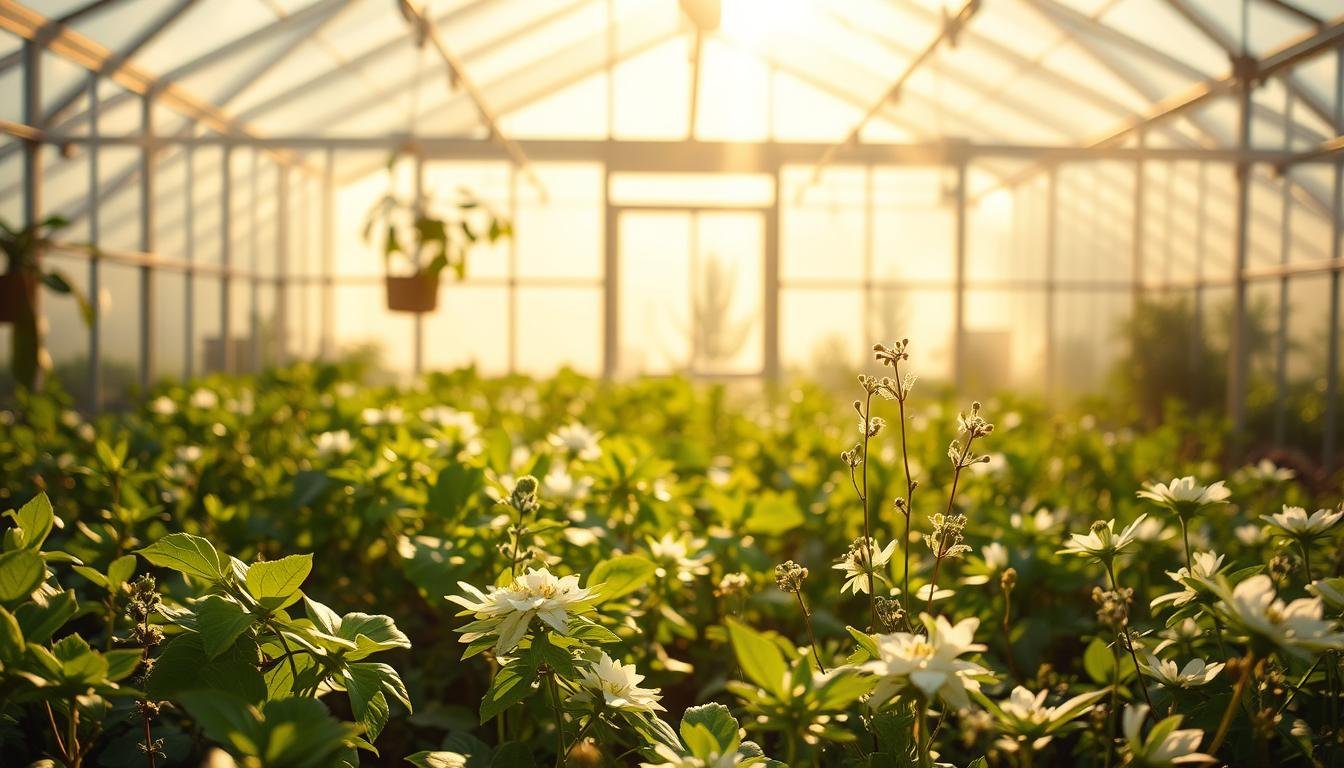
Curious how a clear roof and a pot of soil can change a plant’s fate? That question drives this guide: we show how captured energy, heat storage, and fresh air combine to shape healthy growth.
Glazing (glass or polycarbonate) brings sun inside. Darker surfaces and soil absorb that energy and release warmth after dusk. This thermal buffer helps steady temperatures through the year.
Good ventilation stops overheating and cuts excess humidity. It also supplies CO2, which plants need for photosynthesis. Learn how to use Daily Light Integral (DLI) and Photosynthetically Active Radiation (PAR) to turn those facts into daily steps for better plant growth.
In this guide you’ll find easy rules, simple calculators, and tweaks—like vent timing or fixture height—that change yields. For deeper technical data on transmission and spectrum, see greenhouse light transmission, and for hands-on layout ideas try this urban greenhouse infographic.
Key Takeaways
- Glazing captures energy; soil acts as thermal mass to smooth night temperatures.
- Balance intensity, spectrum, and hours using DLI and PAR for steady growth.
- Ventilation controls heat, humidity, and CO2—key for healthy plants.
- Small tweaks—vent timing or fixture height—often yield big results.
- This guide gives practical steps and tools to plan a week of lighting and tasks.
Why light science matters for greenhouse gardeners today
Knowing how much usable energy plants get each day links simple actions to real results. Mastering DLI, intensity, and run time helps you give seedlings and crops exactly what they need without wasting power.
Knowing the actual amount of usable energy your plants get each day changes how you schedule lights and sowings.
Seedlings stretch when they lack enough light. Many sun-loving starts under older T8 fixtures must run very long—sometimes up to 22 hours—to reach ideal daily light totals.
Higher-quality LEDs often hit the same daily target with fewer hours. That trade-off—more intensity versus more hours—is a practical decision you can make based on cost and timing.
Ventilation matters too. Fresh air tops up CO2 so photosynthesis runs well and growth stays strong.
Use simple cues: compact stems, leaf color, and steady rate of growth to judge whether your setup gives enough light per day. With a few rules of thumb, you’ll schedule sowing and transplant dates with confidence and protect crop quality.

How a greenhouse handles light: capture, conversion, and retention
Greenhouses bring sunshine in, turn it into stored warmth, and slow heat loss so interior conditions stay steadier than outdoors. This buffering helps plants avoid sharp swings across the day and night.
How glazing controls transmission
Transparent or translucent covers like glass and polycarbonate determine how much sun reaches the crop. Thicker panels cut transmission but add insulation and durability.
Interior paint, benches, and floor surfaces absorb solar energy. They change the energy’s form and affect how much useful light reaches leaves.

Why sunlight becomes trapped as heat
Sunshine enters mostly as short wavelengths. Surfaces inside re-emit longer-wavelength infrared.
That infrared passes poorly through the cover, so the space warms—the familiar warming effect everyone notices on sunny afternoons.
Soil as thermal mass and managing vents
Soil stores daytime warmth and releases it overnight. This thermal mass smooths temperature highs and lows and protects young plants from cool nights.
Ventilation still matters: vents dump excess heat, lower humidity, and bring fresh air with carbon dioxide for photosynthesis. Proper vent timing prevents stress and disease.
- Example: On a bright afternoon, open roof vents to shed heat while keeping enough sunshine for steady growth.
- Glazing also shields crops from wind, hail, and pests, and lets you control water instead of relying on rain.
Photons, wavelength, and what plants actually use
Plants respond to particle counts and colors together: count the photons, then match the spectrum. This tells you how much useful energy lands on leaves and whether fixtures waste watts on bands plants ignore.
Plants don’t care about color names — they count photons. The 400–700 nm band is called photosynthetically active radiation. We measure intensity as PPFD: how many photons hit a square meter each second.
How do you count useful photons?
A PAR meter reads PPFD in µmol m−2 s−1. That value gives the number photons arriving per second. Higher PPFD means higher light intensity at the canopy and often faster growth—until you hit a crop’s limit.
Why wavelength matters
Wavelength sets a photon’s job. Blue and red photons drive leaf development and photosynthesis most efficiently. Green still reaches lower leaves and aids plant use in a full canopy.
What practical choices follow?
- Use PPFD to compare fixtures and set mounting height.
- Favor spectra that deliver efficient PAR rather than just bright, human-friendly output.
- Measure actual PPFD at crop level — don’t guess from bulb specs.

| Band | Wavelength (nm) | Typical plant role | PPFD guidance (µmol m−2 s−1) |
|---|---|---|---|
| Blue | 400–500 | Leaf growth, compact form | 50–150 (seedlings) |
| Green | 500–600 | Canopy penetration, shade support | 20–80 (supplement) |
| Red | 600–700 | Photosynthesis, flowering cues | 100–400 (crop dependent) |
Daily Light Integral (DLI): the plant’s “light bucket”
Daily Light Integral (DLI) totals the useful PAR photons a crop gets across a whole day. It’s measured as moles per square meter per day and tells you how long and how bright to run lights.
Think of DLI as a bucket that fills with photons. The light integral sets a target you can meet with many short bursts or fewer intense hours per day.
How is DLI defined?
DLI equals the total moles of PAR that fall on a surface per square meter per day. It converts PPFD (photons per second) into a clear daily number.
Do I run long hours or raise intensity?
Higher intensity means fewer hours per day to reach the same DLI. Avoid a “fire hose” of intensity — too much at once can stress plants and waste energy.
Which crops need more DLI?
Sun loving crops and fruiting stages need higher DLI than shade-tolerant types or young seedlings. For example, a tomato seedling may reach its daily target in ~5 hours of full sun but need ~22 hours under old fluorescents.
Does season change the plan?
Yes. Winter and short days lower natural DLI across the United States. Add supplemental runs and buffers for cloudy days to keep plant development steady.

| Crop type | Typical DLI (mol·m-2·day-1) | Example hours per day (full sun) | Example hours per day (low-output fluorescent) |
|---|---|---|---|
| Seedlings | 6–12 | 2–5 | 12–22 |
| Leafy greens | 12–17 | 4–8 | 18–24 |
| Sun loving fruiting plants | 20–30 | 6–10 | — (often impractical) |
science light greenhouse gardening
Match your site’s sun access, structure, and fixtures to the crops you plan to grow. This short plan ties seasonal shifts to practical steps so you get steady results across the time year.
Start by checking daily sun on the site. Pick glazing that balances transmission and insulation for your local conditions.
Choose fixture types for efficiency and control. Measure actual output rather than trusting labels.

- Use this guide to match the calendar to real yearly light availability.
- Set weekly intensity targets and daily run times so your plants never fall behind.
- Keep fixture height, cleaning, and maintenance on a simple schedule—dust cuts output fast.
- Design layout to reduce shading from frames and add safe reflectors to capture spill light.
- Document changes and results. Small, steady tweaks improve harvests over the year.
Intensity, quality, and daylength: three levers, different outcomes
Intensity drives how fast you fill DLI, quality improves how efficiently plants use photons, and daylength signals seasonal responses. Balance all three to meet targets without wasting energy.
How strong should the beam be?
Light intensity (PPFD) tells you how many photons arrive each second. Higher PPFD means fewer hours needed to reach daily totals.
Remember that intensity drops with distance. Move fixtures closer for quick gains, but keep safe ranges to avoid bleaching or heat stress.
Does spectrum change outcomes?
Quality means the spectrum inside PAR. Better spectra raise plant use efficiency and can cut runtime.
Use full PAR mixes for strong leaf tone and yield. A small spectrum tweak often improves morphology more than extra hours.
When does daylength matter more than intensity?
Photoperiod sets the crop’s calendar. It triggers flowering and signals the time year, independent of total daily photons.
Don’t confuse long low-intensity days with true DLI. For fast wins, raise intensity first; then refine spectrum and daylength.
“Adjusting height by a few inches can double PPFD — a simple example that cuts runtime and saves energy.”

- Tip: Start with intensity, confirm with a meter, then tune spectrum and hours for steady plant growth.
Measuring and calculating light for real-world decisions
A simple PAR meter reading can turn guesswork about hours into a reliable schedule. Use quick measurements to set runtimes, check uniformity, and fix trouble spots before crops fall behind.
How do I use a PAR meter to estimate PPFD and DLI?
Position the sensor at canopy height and take several readings across the bench. Most meters report photosynthetically active radiation in µmol m−2 s−1 — that is the number photons per square meter per second.
Convert PPFD to DLI by averaging readings and multiplying by total seconds of runtime. Track values and log changes after you move fixtures or alter hours.

How can I estimate without instruments: reading seedlings and growth?
If you lack a meter, watch seedlings closely. Tall, thin stems and wide leaf spacing mean insufficient light. Adding output stops further stretch but won’t undo earlier elongation.
- Quick fixes: lower fixtures, add another light source, or increase hours per day.
- Map hot spots from old fluorescents — ballast heat can scorch nearby leaves, so balance intensity and airflow.
- Clean lenses and covers; dust cuts useful light and wastes power.
“Measure at the crop level, log PPFD and hours, then repeat after each tweak.”
Natural sunlight vs artificial light in greenhouse production
Decide when to trust the sun and when to flip on fixtures based on season and crop needs. Use natural daylight first for cost-effective growth, and add artificial light only when daily PAR totals fall short.
When is the sun enough?
When the sun is enough: examples by season and crop stage
In bright spring and early summer, many transplants get *enough light* naturally. Seedlings and leafy greens often meet DLI targets on clear days.
For short winter days or for sun loving crops, natural hours drop. In those cases, plan supplemental runs to hit crop-specific DLI goals.
Supplemental lighting: calculating run time to reach target DLI
Measure PPFD at canopy level, convert to DLI, then subtract natural DLI to find the deficit. Divide that deficit by your fixture’s daily contribution to get required hours per day.
- Practical tip: Many transplants near outdoor plant-out dates don’t need extra runs.
- Where higher DLI matters, balance the cost of power and fixtures against faster schedules and quality.
- Track cloudy stretches and add hours day-by-day to keep growth steady.
Mounting height matters: intensity drop-off with distance
Intensity falls quickly with distance. A common example shows an LED bar at 8″ can meet a target in about 8 hours, while the same bar at 20″ needs roughly 16 hours to reach the same DLI.
Lower fixtures to cut runtime, but keep light intensity safe for delicate stages and maintain good airflow so added heat doesn’t stress plants.
“Use sun-first strategies in greenhouse production and reserve artificial light for gaps — that saves energy and keeps plant schedules predictable.”
Choose the right light source for your beds. Check coverage and uniformity, coordinate venting when you run lamps, and record seasonal results to refine future plans. For kit ideas and practical pots for indoor starts, see indoor herb garden pots.
Choosing and setting up a light source for seedlings and crops
Pick efficient fixtures, set the right heights, and schedule hours to hit DLI targets with minimal waste. A clear plan helps you match output to crop needs and avoid surprise heat or stretching.
Which types of fixtures work best?
Compare common types and pick by bench layout and budget. T8 shop fixtures are affordable and can serve seedlings well if kept close.
Quality horticultural LEDs deliver higher PPFD in fewer hours. Cheap LEDs often underperform and raise runtime.
How many hours should I run them?
Use sample plans: high-quality LEDs often need about 10–14 hours per day. T8 shop lights may run up to ~22 hours to reach the same daily totals for many seedlings.
Place the light source within about 12 inches for T8s. Raise fixtures as plants grow to avoid burn.
What about heat, safety, and water?
Fluorescent ballasts make hot spots—check leaves under fixtures and add airflow. Keep vents or fans on short cycles when rigs run long.
As output and light intensity increase, raise watering slightly. Higher PPFD raises transpiration and plant demand for water.
| Fixture type | Typical run hours | Placement | Key risk / tip |
|---|---|---|---|
| T8 shop lights | 12–22 hours | ~8–12 in. above canopy | Affordable; watch ballast heat and long runtimes |
| Quality horticultural LEDs | 10–14 hours | 12–24 in. depending on model | Higher PPFD, shorter hours, better uniformity |
| Cheap LEDs / generic | Variable; often longer | Manufacturer guidance | May not reach DLI; verify output with a meter |
“Confirm output with a meter, log hours day and distance, then adjust rather than guessing.”
Routine: clean lenses weekly, lift fixtures as seedlings grow, and note hours to refine your schedule. Good records save time and improve harvests.
Light, temperature, humidity, and CO2: integrating the environment
Match air, moisture, and heat so photosynthesis runs smoothly and plants avoid stress. Good ventilation balances temperature and humidity while refreshing carbon dioxide for steady growth.
How should I use ventilation for temp, humidity, and CO2?
Venting and circulation fans dump excess heat and cut humidity spikes. That prevents stressed leaves and lowers disease risk.
Fresh air also restores carbon dioxide inside sealed spaces. Without exchange, photosynthesis slows even when there is enough light.
How do I balance light with water and soil for steady growth?
More light raises leaf temperature and transpiration. Increase irrigation slightly and check nutrients so the plant keeps pace.
Keep soil evenly moist but not waterlogged. Soil stores heat and helps steady night swings.
Align watering to the main day lighting period to avoid overnight humidity that invites disease.
“If growth stalls despite enough light, check temperature, moisture, and CO2 before adding fixtures.”
- Tip: Monitor VPD to optimize gas exchange and disease control.
- Document temperature, humidity, PPFD, and irrigation so patterns become clear.
- Balance fertilizer/EC with light level so plant metabolism stays healthy.
| Issue | Cause | Quick fix | Preventive step |
|---|---|---|---|
| Slow growth despite enough light | Low CO2 or cool temps | Increase vent cycles and warm air slightly | Log CO2 and temp; set timed exchanges |
| Leaf wilting | High transpiration, low water | Raise irrigation frequency; boost airflow | Match water to PPFD and stage |
| High disease pressure | Night humidity, poor circulation | Run fans overnight and reduce evening watering | Align irrigation to daytime and monitor VPD |
Conclusion
A simple meter and a short checklist can turn guesswork into steady harvests. Log PPFD, convert to the daily light integral, and set hours to match crop needs.
Plan for consistent greenhouse production. Measure the number photons your light source delivers to know how many photons hit a square meter per bench. Convert that to DLI and decide the hours per day you need.
When natural sun falls short for the time year, add efficient artificial light at safe heights. Keep ventilation tuned to support CO2, temperature, and humidity so plant growth stays steady.
Track hours day, fixture height, and results. For practical setup tips and transmission data, see this greenhouse illumination guide, and for starter kit ideas try this hydroponic herb garden resource.
Keep it simple: measure, schedule, and adjust. When you confirm enough light first, temperature and moisture fixes make plant growth reliable all year.
FAQ
What is PAR and why does it matter for plants?
PAR (Photosynthetically Active Radiation) is the range of wavelengths plants use for photosynthesis, roughly 400–700 nm. It matters because the number of PAR photons hitting a plant determines how much carbon it can fix and how fast it grows. Growers track PAR with PPFD (photosynthetic photon flux density) to match light to crop needs.
What does DLI mean and how do I use it?
DLI (Daily Light Integral) is the total number of photosynthetic photons delivered per square meter each day, measured in moles·m⁻²·day⁻¹. Use DLI targets for specific crops—seedlings need lower DLI than sun-loving vegetables—and adjust hours or intensity of supplemental lighting to meet those targets.
How many photons hit a square meter per second under full sun?
Full midday sun can deliver roughly 1,800–2,200 µmol·m⁻²·s⁻¹ of PPFD. That converts to a high instantaneous photon rate; integrated over the day it helps produce a DLI in the 40–50 mol·m⁻²·day⁻¹ range on very bright days.
How many hours of supplemental lighting do seedlings need?
Seedlings typically need 12–16 hours of usable light daily, with a PPFD of 100–300 µmol·m⁻²·s⁻¹ depending on species. Aim for a DLI of 6–12 mol·m⁻²·day⁻¹ for many young plants; increase intensity or duration for larger targets.
Can I substitute intensity for hours to reach a DLI target?
Yes. DLI equals PPFD multiplied by time. You can increase intensity for fewer hours or run lower intensity longer. Avoid very high intensity for short bursts that stress plants or raise canopy temperatures—steady, adequate intensity over time usually gives better growth.
How does spectrum affect plant growth and efficiency?
Plants respond differently across wavelengths. Blue and red are most efficient for photosynthesis, while far-red and green influence morphology and canopy penetration. Horticultural LEDs let growers match spectrum to crop goals—compact seedlings, strong stems, or flowering cues—improving photosynthetic efficiency per watt.
When is natural sunlight enough and when is supplemental light needed?
In summer many crops receive sufficient DLI from the sun. Supplemental light is typically needed in winter, on cloudy days, or during critical growth stages (seedling, flowering) to reach crop-specific DLI. Use local seasonal DLI data to decide.
How does glazing affect how much usable light reaches plants?
Glazing types (glass, polycarbonate, acrylic) differ in transmission across wavelengths and in diffuse vs direct light. Clean, high-transmission glazing preserves more PAR; diffuse glazing improves canopy uniformity. Account for transmission losses when calculating DLI inside a structure.
What is PPFD and how do I measure it?
PPFD (photosynthetic photon flux density) measures the number of PAR photons landing on a surface each second (µmol·m⁻²·s⁻¹). Measure PPFD with a calibrated PAR meter or quantum sensor across the canopy to estimate current light levels and calculate DLI.
How can I estimate DLI without a meter?
Rough estimates use local solar radiation tables or smartphone apps that translate sunlight to PPFD, then multiply by hours of effective light. You can also observe plant cues—elongated stems, slow growth, or pale leaves suggest low DLI; compact, robust growth suggests adequate light.
How does distance from the fixture affect intensity?
Intensity falls with distance. For point sources, PPFD drops roughly with the square of the distance; LEDs with lenses may show other patterns. Keep fixtures close enough for target PPFD but far enough to avoid heat or photodamage. Check manufacturer spacing charts.
Which light sources are most practical for seedlings and small crops?
Horticultural LEDs are energy-efficient, spectrally tunable, and run cooler than traditional HID or fluorescent options. T5 fluorescents still work well for small trays. Choose products from trusted brands like Philips, GE, or Fluence and size them to reach your DLI goals.
How do I calculate run time for supplemental lights to reach a target DLI?
Convert fixture PPFD at canopy height to a DLI contribution: DLI (mol·m⁻²·day⁻¹) = PPFD (µmol·m⁻²·s⁻¹) × hours × 3.6 ÷ 1,000,000. Rearranged, hours = target DLI × 1,000,000 ÷ (PPFD × 3.6). Use that to plan daily run time and avoid over- or under-lighting.
How do light, temperature, humidity, and CO2 interact?
These factors work together. Higher light increases photosynthetic demand for CO2, and warmth speeds metabolism but may raise transpiration. Balance ventilation and humidity control with light levels, and consider CO2 enrichment when PPFD and DLI are high to boost growth.
How does soil thermal mass help buffer day–night temperature swings?
Soil and water absorb heat during the day and release it at night, smoothing temperature swings that stress roots and seedlings. Using darker mulches or increasing pot volume increases thermal mass, helping retain warmth when light (and incoming heat) drops.
What DLI ranges suit sun-loving vs shade-tolerant crops?
Shade-tolerant plants often thrive at 5–12 mol·m⁻²·day⁻¹. Many sun-loving vegetables prefer 15–30 mol·m⁻²·day⁻¹ or higher. Seedlings usually need lower ranges initially, then higher DLI as they mature. Match targets to specific crops and life stages.
How do I avoid heat and safety issues with grow lights near water?
Use waterproof-rated fixtures, keep ballasts and drivers away from splash zones, and ensure good airflow to prevent hot spots. Follow manufacturer clearance and wiring guidelines, and place lights above the canopy at safe heights to minimize contact with misting or irrigation.
What practical signs tell me lighting is adequate or insufficient?
Adequate lighting yields steady, compact growth, rich leaf color, and quick development. Insufficient lighting shows leggy stems, small pale leaves, slow formation of true leaves, and delayed flowering. Track growth rates and adjust DLI, spectrum, or photoperiod accordingly.
Where can I find reliable DLI and PPFD references for my region?
University extension services (e.g., University of California, Texas A&M), USDA climate data, and horticultural handbooks provide regional solar radiation and recommended DLI ranges. Use those trusted sources when planning seasonal lighting strategies.