Have you ever stood by your garden at dawn and heard a high, sharp sound that steals the calm? That little noise can feel worrying. It also hints at a simple fix you can do without tearing up planting beds.
Here’s the problem in plain language: a drip irrigation hose makes a high-pitched whistle while the gauge still reads 25 PSI. This is common and usually fixable with quick checks and a few safe steps that protect plants and conserve water.
In this guide you’ll get fast checks first, then a gentle dive into deeper causes: restrictions, valve behavior, regulator issues, vibration, and tiny leaks. A tiny change in flow often changes the sound right away — a useful diagnostic trick that helps you find the problem part.
Expect practical outcomes: identify likely causes, confirm them with simple tests, and apply a targeted fix instead of replacing the whole system.
Key Takeaways
- That high-pitched noise usually means water is forced through a tight spot.
- Start with quick flow checks before disassembling fittings.
- Small adjustments often change the sound and reveal the source.
- Focus on plant-friendly steps that avoid flooding beds.
- Most fixes target filters, emitters, valves, or minor leaks.
What the whistling sound at 25 PSI usually means in a drip irrigation system
A high, music-like tone usually signals that water is being forced through a narrow spot in your irrigation setup. Listen closely: the note, how it starts, and where it seems loudest all give clues you can act on.
The core idea is simple: a whistling sound typically means water is squeezing through a reduced opening. That narrowed path speeds the water flow and turns the component into a tiny instrument.
Even with moderate water pressure, small passages—like clogged filters, worn washers in a valve, or a cracked end cap—can boost local velocity and create a tone. Noise often shifts or stops if the flow rate changes slightly.
Common sound patterns and what they hint at
- Steady whistle: a stable restriction such as a filter mesh or an emitter.
- Shriek or high-pitched spike: may point to cavitation or resonance in a valve or regulator.
- Humming: usually vibration of a part or tubing rubbing against a hard surface.
Check typical components: timer manifolds, zone valve boxes, backflow units, pressure regulators, inline screens, and end-of-line flush caps. Note when the noises begin—immediately or after the system runs a minute—and whether other zones change the sound when they start.
Quick safety and setup checks before you start troubleshooting
Begin with a few simple checks that rule out obvious causes fast. These steps protect your plants and help you focus repair efforts where they matter most.
Confirm the sound comes from the irrigation supply and not a nearby appliance or wind. Turn your attention to the zone while it runs. If the noise keeps playing when you quickly shut off the water supply, look beyond the pipes for the source.
How to confirm the noise is from the supply
- Run the zone and listen; compare with other household sounds like AC or indoor plumbing.
- Record a 10-second video of the noise and note the gauge reading at the same time.
- If the noise stops when the zone is off, the supply system is the likely culprit.
Safe shutoff basics
- Turn the zone off at the controller first.
- Close the zone valve in the field if it’s reachable.
- If needed, close the main irrigation shutoff, working slowly to avoid water-hammer stress.
Quick setup checks that save time: verify the filter faces the correct direction, confirm the regulator orientation, and ensure zone valves are fully open when testing. Keep cycles short in hot weather so your home beds do not dry out.
| Check | Action | Why it helps |
|---|---|---|
| Zone controller | Turn zone off, then on | Confirms if noise is tied to that supply zone |
| Zone valve | Close slowly, reopen fully | Prevents water-hammer and reveals valve faults |
| Filter & regulator | Verify orientation and fittings | Correct install often stops abnormal noise |
| Observation | Record short video and PSI reading | Captures the moment and speeds later maintenance |
Pinpoint where the whistle is coming from in your system
Listen, then move: a short sweep often tells you if the sound is local or affecting every zone. That small routine saves time and protects plants.
Localized vs. widespread: if only one zone sings, suspect that zone’s filter, valve, pressure regulator, or tubing. If every zone hums, the main shutoff or an upstream restriction is likely the source.
Walk-the-line method: start at the timer or valve box and walk the route. Pause at each fitting, filter housing, regulator, and end cap. Note where the tone gets loudest — that is usually the problem spot.

Use tiny flow changes as a test: while the sound runs, open or close a valve a quarter turn and listen. If the noise stops or shifts, you’ve found a resonance or choke point tied to pressure and flow.
Worse over time? mineral deposits and trapped debris often narrow passages. Flushing helps, but scale may need section replacement or a targeted clean.
- Use a screwdriver as a listening probe against valve boxes.
- Feel tubing with your hand for vibration near fittings.
- Do not overtighten filter bowls or crank valves under pressure — that can cause new leaks.
When one zone needs repeat attention, consider linking repairs with your regular maintenance plan or a simple DIY pot watering setup for easier checks and fewer surprises.
Flow restriction is the most common cause of a whistling drip line
Often the sound signals a squeeze point where flow must speed through a smaller opening. This speeds the stream and can make pipes and tubing sing at that choke point.
How restricted flow creates a note
When water flow must pass a reduced opening, velocity rises and the moving stream excites edges and gaps. That vibration becomes an audible tone inside small pipes and fittings.
Mineral deposits and internal narrowing
Hard-water scale and mineral deposits slowly cut the inside diameter of emitters and micro tubing. Flushing may clear grit but not fixed scale, which shrinks passages and raises local velocity.
Debris, silt, and clogged parts
Well sediment, seasonal flushing, or municipal work can dump grit that clogs filters and plugs emitters. Check filter screens and clean or swap clogged pieces.
Undersized runs and velocity issues
Long or too-small mains push water faster at bottlenecks. You can still have low gauge readings while local water flow spikes at a restriction.
- Clues: reduced end-of-line flow, uneven emitter output, or slow wet-out in a zone.
- Check: clear the filter, inspect emitters, and look for kinks or crushed poly under mulch.

For a related watering upgrade, see greenhouse rain barrel system.
Valve-related issues that create uneven flow and whistling noises
Valves often hide their role in odd garden noises until you open a box and listen. They control flow, so any restriction or wear can turn steady supply into vibrating sound.
Partially closed or faulty shut-off valves
A partly closed shutoff will cut flow and raise velocity through the seat. Look for a handle that is not aligned or feels stiff.
If a zone never delivers full output, the valve may be partly closed or damaged. Gently move the handle while the zone runs and listen for change.
Worn washers and internal parts that vibrate under flow
Worn diaphragms, washers, or loose springs can flutter and make a sharp tone as water passes. Small flow changes often stop the sound.
Zone control valves and backflow assemblies as noise sources
Check valves, anti-siphons, and backflow devices can also sing if debris prevents full opening or hits a resonant spot.
Quick tips:
- Open and close valves slowly when testing.
- Clean upstream filter before replacing parts.
- If noise centers in the valve box, start repairs there rather than in the bed.
| Component | Likely issue | Simple fix |
|---|---|---|
| Shut-off valve | Partial closure or stiff stem | Align handle; lubricate or replace valve |
| Diaphragm/washer | Wear or tearing | Inspect and swap the part |
| Backflow/anti-siphon | Debris or partial opening | Flush, clean, or service assembly |
Pressure regulator and pressure/velocity problems even when the gauge reads 25 PSI
The gauge gives a snapshot at one point, but regulators and fittings shape how water moves elsewhere. That difference often explains why piping sounds off even with normal readout.
Why a steady reading can still let noisy flow occur. A pressure regulator sits downstream and protects zones, but its internal parts can flutter or resonate. That flutter makes local turbulence and higher velocity through tiny passages, producing a sharp tone while the gauge stays near 25 PSI.
How regulator behavior creates a tone
A regulator compensating for changing water pressure can chatter when flow is near its operating threshold. Parts move slightly and can act like a reed, especially if a seat or spring is worn or dirty.
Pressure spikes from supply systems and pumps
Municipal changes during hydrant use or a running pump can send brief pressure surges down the supply. Those spikes make a marginal restriction sing when otherwise things seem fine.
Simple homeowner test and next steps
While the zone runs and the sound plays, reduce flow at the main shutoff about half a turn. If the tone drops or stops immediately, you’ve likely found a velocity/resonance problem rather than a random defect.
Careful adjustments: make only small turns and then check emitter output so plants keep getting water. If quieting the flow helps, focus on cleaning filters, clearing scale, and stabilizing the regulator rather than replacing long stretches of tubing.
For more on pipe noise diagnosis and real-world examples, see water pipe noise diagnosis.
Cavitation, vibration, and “harmonic” noise in drip irrigation lines
Sometimes the garden sings because tiny vapor bubbles pop under pressure inside a narrow fitting. This section explains how that bubble action and simple resonance turn routine flow into a sharp shriek, and how small changes often stop the sound immediately.

What cavitation is and why it can sound like a high-pitched shriek
Cavitation forms when fast-moving water creates tiny vapor pockets that collapse with force. That collapse can make a sharp, high-pitched sound rather than a soft hiss. In small emitters and tight fittings, the effect is louder because energy concentrates in a tiny spot.
Why a small change in flow rate can stop the whistle instantly
The system can hit a resonant flow where parts vibrate together. Shift the flow a little and the resonance breaks. Gardeners often stop the noise by easing a valve a quarter turn or by clearing a marginal restriction.
Loose supports and contact points that amplify sound
Vibration travels through tubing and metal. When tubing rubs a valve box lid, fence, or siding, a faint vibration becomes a loud noise you hear across the yard.
- Re-route tubing away from hard edges.
- Use soft clamps or foam pads at contact points.
- Loosen tight bends that hold tension in the line.
Quick caution:
Persistent vibration can fatigue fittings and cause long-term damage. Fix it even if the system still waters plants.
| Problem | How it sounds | Quick fix |
|---|---|---|
| Cavitation at a reducer | Sharp, shrill spike | Smooth transition or larger connector |
| Harmonic resonance | Steady high tone | Adjust flow slightly; test valve half-turns |
| Vibration on hard surfaces | Amplified hum or rattle | Pad contact points; add soft clips |
Leaks, damaged fittings, and end-of-line issues that can whistle
Small openings and worn connections often make the loudest, most persistent garden noises. Fixing them saves water and protects plants from uneven moisture.
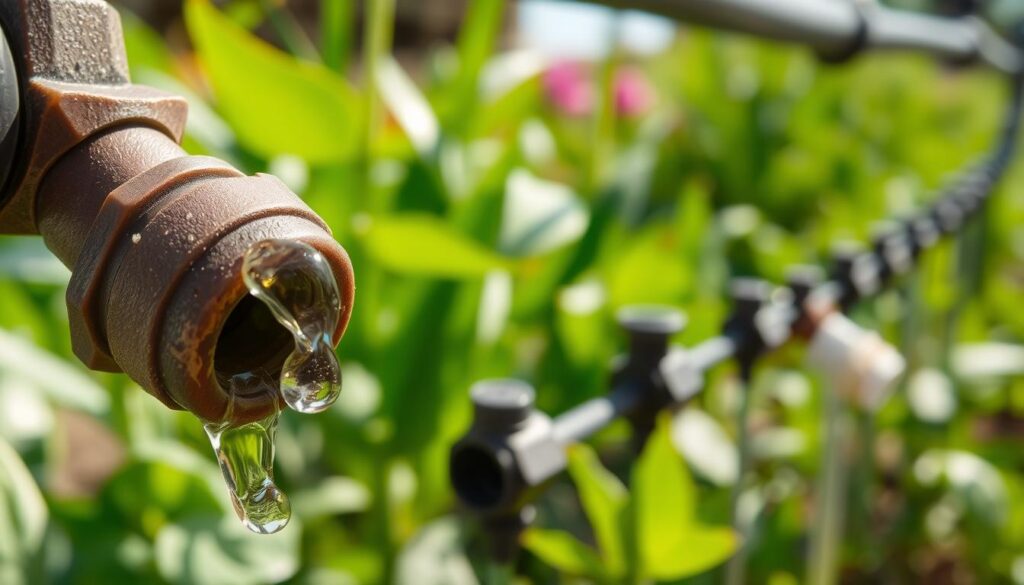
A tiny gap at a barb or threaded adapter can sing loudly even while the rest of your system seems calm. A micro-gap forces a thin jet of water that produces a clear, high tone. That jet can waste surprising amounts of water over a season.
Signs of micro-leaks and damaged tubing
- Look for a consistent wet spot, shiny mulch, or a fine mist near a coupling when the zone runs.
- Check for pinholes, brittle sections from sun damage, and rodent chew marks along runs.
- Loose fittings and worn seals can vibrate, which widens small cracks and increases water waste.
End fittings and end-of-run problems
An end cap not seated fully or a flush valve that forms a nozzle will create a focused stream. Long runs often change pressure dynamics near the end and make emitters jet.
| Issue | Common signs | Quick fix |
|---|---|---|
| Micro-leak at barb or thread | High-pitched jet, damp soil | Tighten, add seal tape, or replace fitting |
| Cracked tubing / pinhole | Shiny patch, slow loss of pressure | Cut out and splice or replace the section |
| Loose end cap / flush valve | Focused stream, louder near run end | Reseat cap; use barbed cap or clamp |
Walk each run to its very end. The loudest sound often hides in the last 10 feet. Fixing these problems balances watering and cuts waste while stopping the noise.
Step-by-step fixes to stop a drip line from whistling at 25 PSI
Start repairs with the simplest actions that usually stop garden piping noise fast. Work in a clear order: cleaning and flushing first, then inspect valves and regulators before swapping parts.
Begin with the easy wins—these often solve the problem without buying new components.
Clean the filter and flush the line
Cleaning the filter is the top step. Shut off the supply, relieve pressure, remove the screen, rinse it, and reassemble carefully. Cross-threading can make new leaks and fresh noise.
Flush the line: open end caps or flush valves and run water until clear. This clears sand and debris from emitters and prevents tiny restrictions that sing.
Inspect and fix noisy valves and worn internal parts
Confirm shutoffs are fully open. If a valve feels gritty or sticks, replace worn washers or diaphragms. Localized noise often points straight at the valve body.
Adjust or replace an unstable regulator
If the regulator chatters or pressure is uneven, adjust within manufacturer limits or replace with a quality unit sized for the zone and pump. A steady regulator stabilizes water pressure and quiets flow.
Re-secure lines and isolate vibration
Move tubing away from hard surfaces. Add soft clips or foam pads near valve boxes so vibration does not amplify across your yard.
Replace restricted sections that are scaled or undersized
Mineral deposits, crushed tubing, or undersized runs often need section replacement or upsizing of the feeder. This reduces velocity and ends sustained tones.
Quick retest loop: after each fix run the zone 2–3 minutes and listen. Move on only if the noise continues—this saves time and parts.
| Step | Signs | Action | Why it helps |
|---|---|---|---|
| Filter cleaning | Reduced flow, grit in screen | Shut off, remove screen, rinse | Removes debris that narrows passages |
| Valve service | Gritty feel, localized tone | Inspect, replace washers/diaphragm | Stops flutter and restores steady flow |
| Regulator | Chatter, unstable pressure | Adjust or replace regulator | Stabilizes pressure and reduces resonance |
| Line replacement | Scale, kinks, pinholes | Cut out and replace or upsize run | Lowers velocity and prevents repeat noise |
For a quick hardware upgrade that speeds future checks, consider fitting your hose or service connections with quick-connect fittings.
Conclusion
Most garden piping noise at a normal gauge reading traces to a restriction, a vibrating valve or regulator, resonance/cavitation, or a tiny nozzle-like leak. Confirm the source, localize the loudest spot, then make a small flow change to prove whether the problem is a choke or a fluttering part.
Start with simple fixes: clean filters, flush debris, open and service valves, stabilize regulation, secure tubing against hard surfaces, and replace scaled or undersized runs when needed.
Seasonal checks and a short walk-the-zone inspection keep your water delivery even and your yard quiet. Most issues resolve with one targeted adjustment, so you don’t need to swap the entire system. For helpful gear that speeds maintenance, see our guide to retractable hose reel options.
Need a quick refresher on the exact phrase? Use this for reference: what causes drip line to whistle at 25 PSI [troubleshooting]